


John Dickson Carr (1906 - 1977) was and continues to be the master of the locked room mystery. When you think 'locked room school of mystery', his is the name that automatically pops up. Either as Carter Dickson or John Dickson Carr, he created some of the best murder puzzles ever written. His mysteries are ingenious whodunits with seemingly impossible scenarios, clever casts of often peculiar characters and a wealth of misleading clues meant to confuse the reader and lead him or her totally astray. I'd say he doesn't play fair with the reader, but it really doesn't matter. That's not why you go to Dickson Carr. Or at least not why I've always liked his books.
I began reading John Dickson Carr /Carter Dickson as a very young woman and liked them best because they were so different (I was purposely looking for something a little different) from all my favorite Agatha Christies. In comparison, they are darkly involving books, meant to draw the reader away from the light. These are not 'happy' mysteries. They are mostly gloomy and tortuous and even in the end sometimes, after the explanation, the reader still goes 'huh'? But to me, that's part of the fun. How often can I be fooled? Plenty of times, it seems. Needless to say, none of these convoluted solutions to the crime have anything to do with 'real life', but, in a way, that's part of their charm.
While his two major detectives, Dr. Gideon Fell and Sir Henry Merrivale, are similar in corpulence and brain power (Merrivale more physically active than Fell), the Merrivale books bear the author name of Carter Dickson and the Fell books were published under John Dickson Carr. Whenever I think of Gideon Fell I can't help thinking of the old nursery school rhyme:
I do not like thee, Dr. Fell
the reason why I cannot tell.
But this I know and know full well,
I do not like thee, Dr. Fell.
But in truth, neither of Carr's creations are especially likable, they are not meant to be. They are eccentric thinking machines, pure and simple. (If they remind me of anyone, it's often Dr. Samuel Johnson.) It is within the cast of zany characters that you must look to find someone to like or sympathize with. Perhaps this is the reason why John Dickson Carr's mysteries are not more well known or more widely read today. But the books are so inventive and so craftily written, that I don't really count this as a fault.
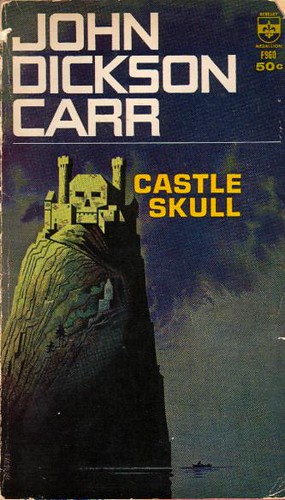
CASTLE SKULL is one of the few puzzlers written by John Dickson Carr which features another of his detective creations, the Frenchman Henri Bencolin. (There are five in this series.)
When I first read this particular book many years ago, I thought then as I do now, that it would make a wonderful film. It's amazing to me that no one has ever tried it.
Bencolin is a brilliant detective mastermind. In appearance he is tall, thin and devilish. He has black brilliantined hair, pointy mustaches and the smile of a satyr. And of course, in dress he is impeccable. He relishes the difficult and the theatrical. No run-of-the-mill cases for him. And in CASTLE SKULL, we are as far from run-of-the-mill as you can get.
This book is all about the atmosphere of setting: an eerie castle on the Rhine river. An edifice meant to resemble the shape of a skull, it fires the imagination and casts a dark spell over boaters up and down the river. There are wild improbable tales of hauntings and mysterious doings, of course. The castle was originally owned by the famed and darkly malevolent magician Maleger, a man who, seventeen years before, went to his own unsolved death, disappearing from a railroad car, his body found downriver, bashed against the rocks. Okay, I know what you're thinking, but you have to wait to find out. Is it a red herring? Only time and Bencolin's machinations will tell.
At present, Bencolin and his 'Watson' and general dogsbody, Jeff Marle who tells the tale in first person, are visiting across the river within view of the ominous castle. Bencolin has been asked to solve the murder of famed actor Myron Alison whose grisly death seems incomprehensible to one and all. Alison was the current owner of Castle Skull, though he and his sister and assorted family lived across the river in a rather more comfortable setting -the castle inhabited lately only by a caretaker, most of the building being left to nature's harsh devices.
On the night of the murder, a rainy, storm tossed night (of course), those in the house were horrified by the vision of a man on fire running along the dark battlements of the castle before collapsing and dying in the shadows. That man was Myron Alison.
The local constabulary has called in the famed German detective and wily rival to Bencolin, Herr von Arnheim. Bencolin has been called in by Monsier Jerome D'Aunay, a troubled, wealthy business man who happened to be visiting with the Alisons at the time of the murder. The two detectives are not only jealous of each other's abilities, but enthusiastically enter into competition to see who can solve the murder first.
There are assorted doings and happenings, secret passageways, boat trips across the Rhine, mostly taking place in a rain-soaked atmosphere full of shadows and dark imaginings. Fun stuff. The castle itself serves as a major character in the story. I'm fond of that sort of thing.
The final denouement, of course, will take place at a mad, high-spirited cocktail party given in the ruins of Castle Skull itself. An occasion in which all will be revealed.
Please check out this website for a list of John Dickson Carr's books, all of which make for great and atmospheric reading but perhaps, not on a rainy night.
It was a breathtaking sight to see Castle Skull illuminated in that fashion and I have no doubt that night-travellers on the Rhine gaped up at it. The vast death's head lifted itself to stare with light. The eyes were enormous oval windows of violet-colored glass! the nose was triangular and yellow, as were also the arches forming the teeth; and all of them shone out in a devilish and sardonic blaze. As the lights moved or fluttered in the least, different expressions played over the face of the skull.
Great spot for a murder - huh? Or, at the very least, a cocktail party.
More flights of steps, past another floor where the dining room was located, and we emerged in the room which made up the entire crown of the skull. Noise rushed out at us; noise buffetted the ear-drums, swirled you again into that half-sick tensity of waiting. I saw that the roof was of glass in the shape of a dome. There were carven pillars of ebony soaring to support it. The floor seemed to be of black-and-gold mosaic in circular patterns of zodiac symbols, but I could not see what symbols because it was strewn with animal-skin rugs...and the animal-heads opened white-fanged jaws like an uncanny dead menagerie. People were tripping over them in all directions. Four immense crowns of candles hanging from the roof gave a fiery glow to the mosaic floor, but even so, the room was not well lighted. I could make out no details; shadow lay everywhere outside the candlelight.
It is in this melodramatic atmosphere that another death will occur and a murderer revealed. It's a kind of mish-mash of an ending, but in this book, it's the route to that ending that counts.
This review is an entry in the Vintage Mystery Challenge hosted by Bev at My Readers Block blog.




0 Comments